Home » news

Saturday, August 9, 2008

Outside

I'm at Outside now. I write and edit there, and contribute to the blog regularly. Here's a sample of some recent stuff:
Field Tested: Tacx Fortius VR Trainer

Twenty-one switchbacks on the legendary Alpe d'Huez. I can tell you what it's like to ride them. I just did. Last night. In my living room. Perched on the amazing Tacx Fortius VR Trainer.

To give you a sense of it, and to best simulate morale-crushing winter weather, we put together a little video in the ugliest indoor area we could find: the basement at Outside. Note that the video mistakenly describes the price as 760 dollars -- those are Euros, we meant to say. But more on that later. Check it out:


I was a VR-is-all-virtual-and-no-reality kind of guy, too. But this simulator takes stationary riding to whole new level, and promises more in the future. The basic idea is to provide a life-like riding environment indoors. To do this, Tacx, a Dutch pro-level maker of trainers and accessories, threw a motorized brake on the flywheel, and hooked it up to a power pack that communicates information between your trainer and your PC (note to Mac users: you're not invited). What you see is what you pedal. Resistance adjusts to match the incline on your screen, from out-of-the-saddle 12 percent verts to coasting descents. Go ahead and bomb: crashes are unlikely.

read the rest here.

Here's a quick Q&A with a solo sea kayaker:
Q&A: Fastest Circumnavigation of Newfoundland

Gps204_editOn July 29, 48-year-old Greg Stamer completed the fastest unsupported solo sea kayak circumnavigation of Newfoundland. He clocked 1306 miles in 44 days on his Greenlander pro, besting the previous record by 22 days, mostly by cutting from headland to headland, and putting in a bunch of over-50-mile days. Floating by the same 'berg fields that produced the one that sunk the Titanic, Stamer camped in the remains of old fishing villages or on spectacular islands with nothing but caribou and the occasional bear. Outside caught up with him by phone on his return to Florida, where he lives with his chow-golden-mix dog, Bear.

How did you do it so fast?

I just pushed harder. I did a lot of long crossings, a lot of which had never been done before by sea kayak. There's this one that's known as "The Rock." A lot of the coastline is sheer cliffs, and that made finding places to land a little difficult. I had topo maps and gps, but you'd plan, and it'd look flat on your map, but you'd get there and find it was a 30-foot cliff.

On the long crossings, you generally don't see land, but if you spot it 26 miles out, it's kind of like Chinese torture, the way [the land] comes up on you so slowly. Or you're completely enclosed in fog -- there was a lot of fog this year. And only two to three days where the wind was actually calm.

Still, you always feel like you have company. I saw hundreds and hundreds of whales. They come up close to the boat and breathe. You hear them, but by the time you turn they're gone. Lots of dolphins, too, playing. One time I heard a gurgling sound at the back, and I thought some kelp had gotten into the drop-down skeg. Olymfreya0026_2
I turned around to look and there was a large grey dorsal fin about two boat lengths back. I spun my boat real quick and got ready to jab it in the nose. Must've thought I was a wounded seal or something. I don't know if that was [the shark's] comment on my paddling stroke.

How did you fuel up?

I paddled around Iceland last summer and lost 22 lbs., so I decided on this trip I was not going to let that happen again. A lot of olive oil. I loaded up on my meals at night. Stopped every hour to snack on high-calorie stuff. I did stop in some of these villages. They eat this dish called poutine, which is fries with fat and more fat. I ate a fair amount of that. I figure my body's a furnace on a trip like this. I only lost 5 pounds this time.

What did you paddle?

I used an all-carbon Greenland style paddle, which has a narrow and unfeathered blade. It's good for long-distances, very quiet. Good for rolling, too. You sweep it through the water, and it's like a big glider. I had a pretty heavily laden kayak, so it's more like being on a touring bike than a racer. You're hauling 4 liters of water, tent, camping gear, 200 pounds of gear. You're not going to wear your racing kit for a tour.

Any screech?

Oh, that's very strong rum they drink up there. I stopped in one place, asked if they mind if I put up a Gps298_edit_3
tent. What they say out there is "Boy" but they pronounce it "bay." So they said, "Won't hear of that, bay, you're comin' inside." So we stayed up drinking rum until 2 in the morning, which probably wasn't a good idea considering [paddling] is almost like running a marathon. But they call it being screeched in. You're supposed to kiss a fresh cod, that's part of the initiation. I didn't do that, but I'm almost a Newfoundlander now.

The people in Newfoundland have to be the most hospitable people in the world. I think it comes from before all the cod moratoriums, when the region was supported by small fishermen. Drownings are very common -- people falling between boats and what-not. So there's a real culture of reaching out and helping, especially on the water. They'll go out of their way to bring you ashore. Here's the keys to the car. Just leave the keys on the tire. That sort of thing. It really restores your faith in people.

-- Matthew Fishbane

photos courtesy: Greg Stamer

Monday, March 31, 2008

Monday Morning Links


Bogota, Barrio Santo Domingo, by excusa2

Revisiting
  • A new golden age for travel writing? In the Guardian (U.K.)
  • The Times put the death of Dith Pran front and center over the weekend, including their slightly-creepy "The Last Word" obituary video series. And the trials? Nuon Chea's not getting any younger.
  • An interesting take on the buzzed-about "implosion" of the FARC, from the CIP. In response, I suspect, to Juan Forero's report earlier in the week.
  • For Spanish speakers, this dispatch from the FARC implosion, by Colombian Hector Abad Faciolince.
  • Teo Ballve on how trade gets thrown into the "security" cocktail, at NACLA.

Monday, March 24, 2008

What Colombia and Frogs have in common


photo: mr. ëd, flickr

Andrew Revkin muses today in Dot Earth on the problem of complexity in newspaper coverage. He's talking about frogs, by way of example, and the post is worth a thorough read (especially following through on to this link to a discussion from On the Media), but his larger topic is the way complex, shifting topics get explained in the press.
What’s a journalist (or citizen) to do? The more definitive a statement, the more effort should go into testing its basis. Somehow, we need to figure out a better way to deal with complexity and uncertainty. That goes for scientists, journal publishers, and definitely journalists and readers.
The problem of the golden frog, it turns out, is the problem of complex political and social realities like those of Colombia. "The more complex or conditional a story is," Revkin writes, "often the less space it is granted."

Monday, March 17, 2008

Monday morning links


Fernando Vergara / AP, from here

borders and migrations
  • Jason DeParle takes a look at the World Bank, in the eighth installment of his globe-trotting series in the New York Times, Border Crossings.
  • New York City accents, from the free daily AM New York. (Feb. 20: I'm late to it, but if you haven't come across this, give a listen.)
  • The bizarre spectacle of the concert "Paz Sin Fronteras" on a border bridge between Colombia and Venezuela. Estimates put more than 100,000 people swarming in the mud pit below the bridge. El Tiempo has splashed news of the concert across its front page all weekend. But did these "chancellors of peace" really succeed in "making the border forgotten" by wearing white? One unhappy partier in this story: President Alvaro Uribe, who was asked by organizer Juanes not to attend. "We're neutral," the rocker said in reference to the concert, "and this is not a political act."
  • Tangentially related, but worth a read: Keith Gessen's look at meritocracy hypocrisy, in the Sunday Book Review.

Contrapposto

Wednesday, February 27, 2008

eyes, all of a sudden, on kidnapping in Colombia


photo: El Tiempo -- (left to right) Luis Eladio Pérez, Jorge Eduardo Géchem, Gloria Polanco and Orlando Beltrán.

With the news today of the release of four former Colombian lawmakers after more than six years in captivity, came a statement from the FARC declaring an end to "unilateral liberations," until demands for a New-York-City-sized distension zone is conceded to the rebels. Good news for the four pictured above. Bad news for the 500 still left, including former presidential candidate Ingrid Betancourt, and three Americans.

While the wires relay developments (all 627 related » at the moment over on Google News), only one article so far puts some of these developments in context, and I recommend taking a look at Kevin Whitelaw's review of the "War on Kidnapping" in U.S. News & World Report, and then follow on to a previous article on the power of both kidnapping imagery and the FARC.

Anyone who sees recent releases as purely positive steps, should reconsider the scope of the conflict. Whitelaw writes:
Places to hide. Kidnapping remains a problem. A number of hostages—U.S. intelligence agencies estimate some 750—remain in captivity. Many are middle-class Colombians, but there are also several dozen high-profile captives, like Ingrid Betancourt, a French-Colombian woman and former Colombian presidential candidate. The guerrillas can still find places to hide in Colombia's jungle, which is almost the size of France. "That's the part of the territory the bad guys still know more about than us," says Colombia's Vice President Francisco Santos. "They have been there for 45 years, and we have been there systematically only for five."
Remember that kidnapping peaked back in 2000 at an astonishing rate of over 3500 a year. Such was the bonanza that armed groups took to calling road blocks and other random kidnapping techniques "pesca milgarosa" or miraculous fishing.

Here's what it looks like to come out of the jungle after 6 years. That's left-wing senator Piedad Cordoba in yellow -- she's been shuttling back and forth to Chavez to help negotiate the release.


Finally, who's still out there? Another excellent post from Adam Isacson, at the Center for International Policy, provides a full update.

More on the aftermath of kidnapping


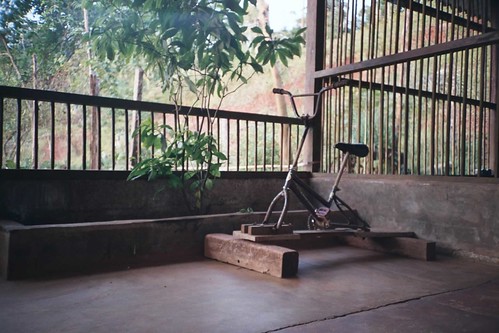
Photo: Luis Perez, flickr -- stationary bike in Chocó

El Tiempo today paints an odd portrait of the Pacific coastal town of Nuqui, Chocó, where, the article leads, 7 people have recently lost their jobs.

They lost their jobs in this remote beach front, accessible only by air and sea, because last month 6 Colombian tourists were taken hostage by the FARC. Nuqui, and the national parks nearby, are a destination for viewing humpback whales at their northernmost migration, and local officials claim that 450 tourists had visited in the two weeks prior to the kidnapping.

Since then, of course, hotel owners have had nothing but cancellations, especially from foreigners. How long does it take for tourist sites to recover from publicized aggression? It had been six years since anything warlike had happened in this sleepy town, said one local. "People die of old age here, life is so relaxed" said the town doctor. "I haven't had my first heart attack."

Last week, the article says, a pair of foreigners arrived. They are being escorted by local military, and the Colombian Tourism Ministry is pushing its all-clear signal as best it can. (The reporting credit includes: "by invitation of the presidency and the authorities of Nuqui.")

One of the recently unemployed is quoted:
"Yo recibía a los turistas en el aeropuerto, compraba el pescado para la comida, arreglaba la planta y bombeaba el agua para las cabañas. Estaba encarretado con la parte turística y feliz porque conocía a mucha gente", dice Moreno, de 29 años
"I received the tourists at the airport, bought fish for dinner, checked the power plant and pumped water for the cabins. I was into the touristic part and happy to meet a lot of people," Moreno, 29, said.
So, following on the Weigel case: can the six tourists be billed for Moreno's lost salary?