
Outside goes live today with an interactive review of events on K2 last August.
Two Wheeled ActREAD the rest of the Q&A at Outside
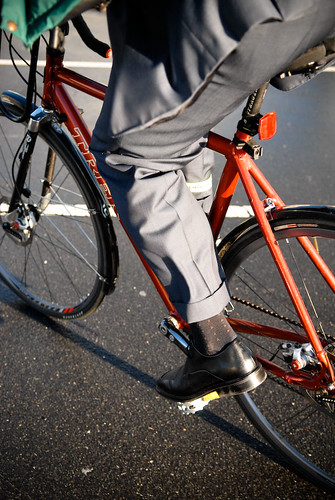
Bike-friendly Congressman Earl Blumenauer talks to Outside’s Matthew Fishbane.
Tucked deep down behind the new leases for off-shore drilling in the Comprehensive American Energy Security and Consumer Protection Act, a broad energy bill that the House passed last week , were the tiny remains of something called the Bicycle Commuter Act. Congressman Earl Blumenauer, of Oregon's Third District, originally sponsored the bill last session in hopes of bringing bicycles into the commuting mainstream by offering reimbursements and subsidies to the calorie-powered. We caught up with the Congressman, who regularly bikes to his DC offices, to talk about bike safety, infrastructure, and how the Portland model might spread.What's the basic idea of the Bike Commuter Act?
The concept is to provide equity for people who burn calories instead of fossil fuel.


SIERRA NEVADA DE SANTA MARTA — I’m trudging down the lower slopes above the city of Santa Marta with a black plastic bag of human bones dangling like a scarf bundle from the handle of my shovel. An assistant to the forensic anthropologist I’ve been shadowing for the past eight days — a big, ribald gravedigger — stops on a ridge overlooking the misty clouds that have rolled in off the Caribbean, and laughs. “Do you want me to carry Doña Tulia?” he asks. That’s what we have taken to calling the woman we exhumed two days ago, a likely victim of paramilitary violence. “Tulia’s no trouble,” I say, more spooked by my nonchalance than by the bones.Read the rest here. Or buy the Walrus -- great publication.
Field Tested: Tacx Fortius VR Trainerread the rest here.
Twenty-one switchbacks on the legendary Alpe d'Huez. I can tell you what it's like to ride them. I just did. Last night. In my living room. Perched on the amazing Tacx Fortius VR Trainer.To give you a sense of it, and to best simulate morale-crushing winter weather, we put together a little video in the ugliest indoor area we could find: the basement at Outside. Note that the video mistakenly describes the price as 760 dollars -- those are Euros, we meant to say. But more on that later. Check it out:
I was a VR-is-all-virtual-and-no-reality kind of guy, too. But this simulator takes stationary riding to whole new level, and promises more in the future. The basic idea is to provide a life-like riding environment indoors. To do this, Tacx, a Dutch pro-level maker of trainers and accessories, threw a motorized brake on the flywheel, and hooked it up to a power pack that communicates information between your trainer and your PC (note to Mac users: you're not invited). What you see is what you pedal. Resistance adjusts to match the incline on your screen, from out-of-the-saddle 12 percent verts to coasting descents. Go ahead and bomb: crashes are unlikely.
Q&A: Fastest Circumnavigation of Newfoundland
On July 29, 48-year-old Greg Stamer completed the fastest unsupported solo sea kayak circumnavigation of Newfoundland. He clocked 1306 miles in 44 days on his Greenlander pro, besting the previous record by 22 days, mostly by cutting from headland to headland, and putting in a bunch of over-50-mile days. Floating by the same 'berg fields that produced the one that sunk the Titanic, Stamer camped in the remains of old fishing villages or on spectacular islands with nothing but caribou and the occasional bear. Outside caught up with him by phone on his return to Florida, where he lives with his chow-golden-mix dog, Bear.
How did you do it so fast?
I just pushed harder. I did a lot of long crossings, a lot of which had never been done before by sea kayak. There's this one that's known as "The Rock." A lot of the coastline is sheer cliffs, and that made finding places to land a little difficult. I had topo maps and gps, but you'd plan, and it'd look flat on your map, but you'd get there and find it was a 30-foot cliff.
On the long crossings, you generally don't see land, but if you spot it 26 miles out, it's kind of like Chinese torture, the way [the land] comes up on you so slowly. Or you're completely enclosed in fog -- there was a lot of fog this year. And only two to three days where the wind was actually calm.
Still, you always feel like you have company. I saw hundreds and hundreds of whales. They come up close to the boat and breathe. You hear them, but by the time you turn they're gone. Lots of dolphins, too, playing. One time I heard a gurgling sound at the back, and I thought some kelp had gotten into the drop-down skeg.
I turned around to look and there was a large grey dorsal fin about two boat lengths back. I spun my boat real quick and got ready to jab it in the nose. Must've thought I was a wounded seal or something. I don't know if that was [the shark's] comment on my paddling stroke.How did you fuel up?
I paddled around Iceland last summer and lost 22 lbs., so I decided on this trip I was not going to let that happen again. A lot of olive oil. I loaded up on my meals at night. Stopped every hour to snack on high-calorie stuff. I did stop in some of these villages. They eat this dish called poutine, which is fries with fat and more fat. I ate a fair amount of that. I figure my body's a furnace on a trip like this. I only lost 5 pounds this time.
What did you paddle?
I used an all-carbon Greenland style paddle, which has a narrow and unfeathered blade. It's good for long-distances, very quiet. Good for rolling, too. You sweep it through the water, and it's like a big glider. I had a pretty heavily laden kayak, so it's more like being on a touring bike than a racer. You're hauling 4 liters of water, tent, camping gear, 200 pounds of gear. You're not going to wear your racing kit for a tour.
Any screech?
Oh, that's very strong rum they drink up there. I stopped in one place, asked if they mind if I put up a
tent. What they say out there is "Boy" but they pronounce it "bay." So they said, "Won't hear of that, bay, you're comin' inside." So we stayed up drinking rum until 2 in the morning, which probably wasn't a good idea considering [paddling] is almost like running a marathon. But they call it being screeched in. You're supposed to kiss a fresh cod, that's part of the initiation. I didn't do that, but I'm almost a Newfoundlander now.The people in Newfoundland have to be the most hospitable people in the world. I think it comes from before all the cod moratoriums, when the region was supported by small fishermen. Drownings are very common -- people falling between boats and what-not. So there's a real culture of reaching out and helping, especially on the water. They'll go out of their way to bring you ashore. Here's the keys to the car. Just leave the keys on the tire. That sort of thing. It really restores your faith in people.
-- Matthew Fishbane
photos courtesy: Greg Stamer


What’s a journalist (or citizen) to do? The more definitive a statement, the more effort should go into testing its basis. Somehow, we need to figure out a better way to deal with complexity and uncertainty. That goes for scientists, journal publishers, and definitely journalists and readers.The problem of the golden frog, it turns out, is the problem of complex political and social realities like those of Colombia. "The more complex or conditional a story is," Revkin writes, "often the less space it is granted."

 Get the feed, snout in the trough.


