Colombia's "El Tiempo" daily reports today on the capture and confinement of a drug smuggler near the Venezuelan border. Police report that the suspect, discovered hiding in a large agricultural sack on a bus, had several bags of coca paste, the basis for cocaine, tied to his legs and wings. The police further note that the suspect was a chicken. The chicken, reports Colonel Richard Portilla, director of operations for regional law enforcement, is being held at the local prosecutors office until further soup ingredients become necessary.
In the last year, several ducks and at least one turkey have also played mule.
Monday, September 24, 2007

Tuesday, June 26, 2007
Khmer Food

Why can't I order out for some good kuy thiew in New York City, supposed food capital of the world? My answer (and some of my nostalgia) at Salon.
Tuesday, May 8, 2007

Friday, April 27, 2007
The Romance of Civilizations

View from Hunter College, 8th floor
Pico Iyer, in conversation with Hal Wake, at the PEN World Voices festival. The "faculty dining room" looks out over what you see above (roughly), and Pico recognizes right away that the audience is made of global souls like himself, to whom he is able to speak without too much explanation. People, that is, with some firsthand understanding of the difference between expat, exile, tourist, traveler, refugee and overseas worker. It may have to do with the fact that this event is one of the few PEN discussions to be admission-free.
On Sri Lanka: "Much more deeply wounded than I first expected."
On Japan: "The most science fictive of places."
"A place where they speak silence."
On Santa Barbara, California: "Comfortable, sure, but it might be that those in the developing world are spiritual millionaires in comparison."
On the next great travel writing: "It's going to places like the Port Authority, to Jackson Heights," recognizing the foreign on your doorstep. Travel writing as pure futurism, trying to anticipate the rapidly arriving. The dance of multicultural being with the multicultural world. "People talk about the clash of civilizations. I like to think of the romance of civilizations." The meeting of two cultures is more like the meeting of two people, not two armies, especially if (as Iyer says he does) cultures can be viewed as characters. They might hit it off in ways just as mysterious as two people will when they meet at a cocktail party. The power relationship in a true multicultural meeting will be that of an affair, not a war: shifting, elusive, power here on some things some times and power there for others -- the goal isn't annihilation but union.
"I compare myself to someone like V.S. Naipaul, who found despair wherever he went, where I see with an optimist's view. He feels alienated everywhere, at home nowhere; and I feel quite the opposite: at home everywhere I go, connecting with whatever part of myself fits."
We seek the vibrancy and dynamism of the cultures of the developing world.
We travel not knowing who is going to come back.
Tuesday, April 17, 2007
Wherein I join Mr. Beller's Neighborhood

Wat Bronx (my photo)
At the northern tip of Mr. Beller's Neighborhood is what passes for New York's Little Cambodia.
Find out Wat is the Wat.
Thursday, April 12, 2007
The looming wordearth is about to fall on your head

It must be spring: the writers are aswarm.
The PEN World Voices festival runs April 24-29, with topics close to OPP's heart. Wednesday's program:
Writers explore what binds us to home and what holds us apart from it, and why home, or the idea of it, is or isn’t worth dying and killing for. How do we find home, and, when we lose it, how do we make a new one? Why do we leave home and why do we long to return? We’ll visit the domestic, the exiled, the global, and the imagined in search of a place we can call our own.Which is what OPP has been trying to explore himself, see.
Not to be outdone by the non-print set, PEN (last bastion of that thing called book) has gone interactive this year:
-- In Home & Away, laypeople like you and me can give our 2 cents on the topic.
-- In the postcard series, you can, well, send a postcard.
Note that of the 166 participant writers listed in "World Voices," only 9 hail from South America, with half of these currently living in the US (*) :
Daniel Alarcon* (Peru)
Mariela Dreyfus* (Peru)
Guillermo Arriaga (Mexico)
Carlos Maria Dominguez (Argentina/Uruguay)
Jorge Franco (Colombia)
Laura Restrepo (Colombia)
Jaime Manrique* (Colombia)
Cecilia Vicuna* (Chile)
Patricia Melo (Brazil)
Same strange idea of "world" (as in baseball's "world" series) when it comes to Asia: sole non-Chinese, non-Indian Asian Tinling Choon of Malaysia, currently at Yale, must stand in for the rest.
There might be something to be learned from former imperial power U.K., which lists only one bona fide 100% U.K. participant, Jo Tatchell, who... oops! ... writes on Middle Eastern culture. The other 9 U.K. participants are slash-U.K. participants, as in "Zanzibar/U.K.", "China/U.K." and even "U.S./U.K.", in that order. Well, what's home, but a place we can call our own, eh?
Sunday, April 8, 2007
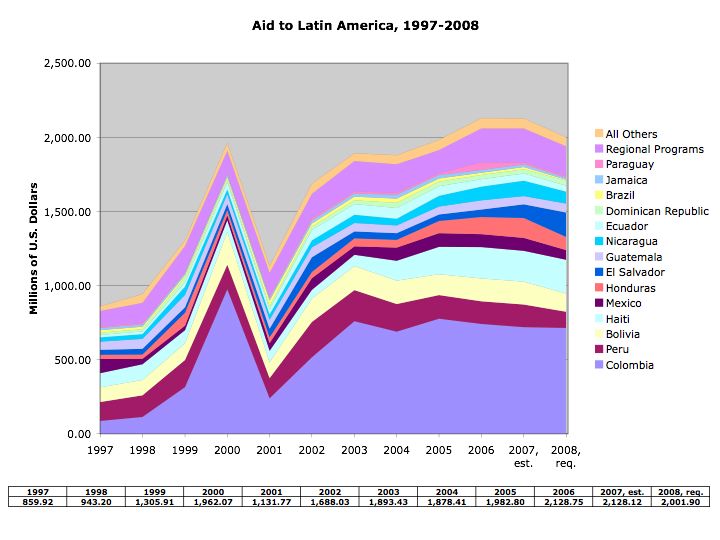
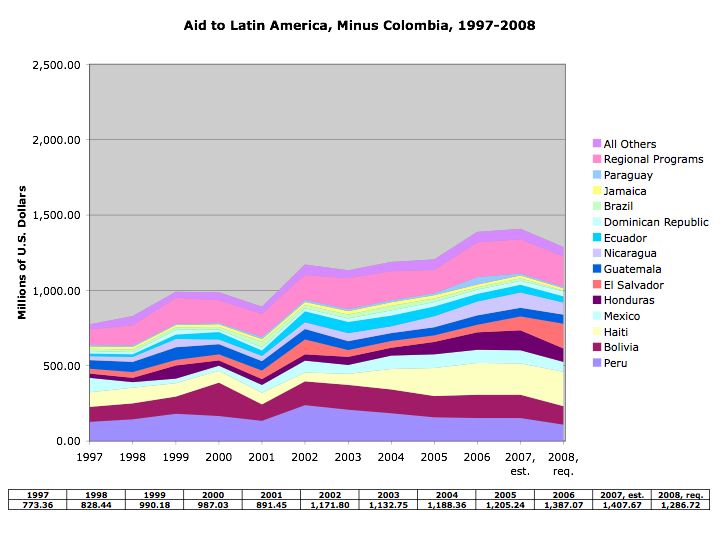
Wherein the Twin Towers appear on a graph of aid to Latin America
Ever wonder where the focus is for US foreign policy in Latin America? The CIP has compiled some truly eloquent graphs.
For a clearer view, the original post from Adam Isacson, here. Note that the scales are the same for each pair of charts, in case you thought there was distortion.
Military and Police Aid to Latin America, by Program, 1997-2006:

Military and Police Aid to Latin America by Program, Minus Colombia, 1997- 2008:

--------------------------------------------------
Aid to Latin America, 1997-2006:

Aid to Latin America, Minus Colombia,1997-2006:
For a clearer view, the original post from Adam Isacson, here. Note that the scales are the same for each pair of charts, in case you thought there was distortion.
Military and Police Aid to Latin America, by Program, 1997-2006:

Military and Police Aid to Latin America by Program, Minus Colombia, 1997- 2008:

--------------------------------------------------
Aid to Latin America, 1997-2006:
Aid to Latin America, Minus Colombia,1997-2006:
Friday, March 23, 2007
"Non-traditional" -- is that like innovative?

(photo: USSOUTHCOM)
The Center for International Policy's Adam Isacson, back from a two-day conference at Southern Command, describes in today's Plan Colombia and Beyond post bravely standing before a room full of Latin American military brass, and telling them that Costa Rica, which renounced its standing army in 1948, has got it right.
He deserves some kind of NGO Purple Heart -- the Purple Barbed-wire-wrapped Candle?
As usual, a thoughtful presentation of a serious, and overlooked, problem in South America: cash-strapped governments sending their militaries out to do traditionally civilian duties, anything from heavy-gunned police and anti-narcotics work to environmental protection in understaffed parks to Chavez's outright use of military for "teaching in schools, building housing, and running neighborhood food kitchens ."
The lines too easily blur, Isacson says, when the military, whose exceptional and definitive task is the obliteration of an enemy, takes over the role of civilian police.
A number of realities are at play:
-- the threat of foreign aggression has all but disappeared, making armies irrelevant, as Costa Rica eloquently demonstrates,
-- internal insecurity and civil disorder make police, on the other hand, supremely relevant,
-- the civil societies in question (for a variety of reasons) are not meeting other civil needs (besides security) through civil government,
-- the easy and short-sighted solution is to fuse all of these, dumping civil jobs on a military that can't say no, and police jobs on a military that doesn't have to answer to civil judges.
Sound like a familiar Latin American two-step toward military rule? Isacson concludes:
The Costa Rican delegation to the conference was clearly proud of, and satisfied with, the choice their country had made back in 1948. As governments throughout the region become ever more worried about internal crime, and defense from foreign aggression becomes ever less a compelling mission, the Costa Rican model seems to make more and more sense. Why not focus all security resources on improving the police - the institution designed to deal with the crime threat that worries citizens the most?
Needless to say, none of the other militaries present, much less Southern Command, voiced enthusiasm for the Costa Rican model. As far as possible alternatives go, it's still a bit too “non-traditional.”
Subscribe to:
Posts (Atom)


